Data Center Consolidation
Status Report
FY 1998-1999
Executive Summary
In January 1997, pursuant to Proviso 17A.5 of the 1996-97 General Appropriation Act, the State Budget and Control Board presented a study to the Governor, Chairman of the Senate Finance Committee, and Chairman of the House Ways and Means Committee recommending the consolidation of eleven agency data centers into one single data center. The General Assembly confirmed this consolidation process through Proviso 17A.5 of the 1997-98 General Appropriation Act and Proviso 63A.5 of the 1998-99 General Appropriation Act. This status report is provided pursuant to Proviso 63A.5 and addresses hardware, software, staffing and facility requirements as well as the financial aspects of data center consolidation.
Summarized below are the major accomplishments of the data center consolidation project during FY 1998-1999.
- The systems integrator developed a high-level Master Plan for consolidation of eleven agency data centers into a single State Data Center.
- Two (2) new mainframe processors were installed at the Office of Information Resources (OIR) in support of the consolidation project.
- The Department of Social Services (DSS) data processing operations were transferred from the DDS data center to the Office of Information Resources (OIR) data center. The old DSS mainframe was retired.
- The Department of Transportation (DOT) data processing operations were transferred from the DOT data center to the Office of Information Resources (OIR) data center. The old DOT mainframe was retired.
- The purchasing power of the state was leveraged to negotiate enterprise-wide system software contracts with major software vendors that resulted in significant cost avoidance.
- Eight (8) staff positions (FTE’s) were transferred from the Department of Transportation (DOT) to the Consolidated State Data Center at the Budget and Control Board.
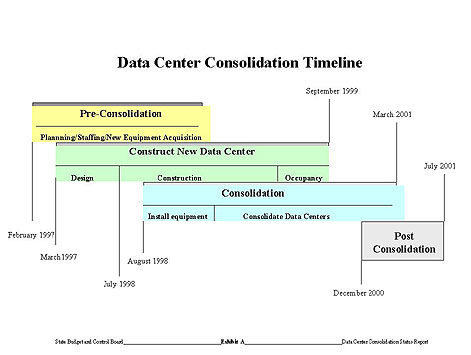
- Construction of the State Data Center Facility proceeded as planned with few delays. The projected date for completion is early September 1999.
Purpose
This report provides an update on the status of data center consolidation in South Carolina state government as required by Proviso 17A.5 of the 1997-98 General Appropriation Act and Proviso 63A.5 of the 1998-99 General Appropriation Act.
This report is submitted to the Governor, the Chairman of the Senate Finance Committee, and the Chairman of the House Ways and Means Committee.
Background
The concept of consolidating data centers in state government was formalized by the General Assembly through Proviso 17A.5 of the 1996-97 General Appropriation Act which required the Budget and Control Board to develop a plan to consolidate data centers. In January 1997, the Budget and Control Board completed its study of data center consolidation and reported its findings. Twelve data centers were studied; eleven were found to be viable candidates for consolidation. They are as follows:
Benefits of consolidation identified in the study include modernization, improved access to information, efficient sharing of resources, compatibility, security, and possible savings of as much as $30 million over a ten-year period.
Based on the findings of the Data Center Consolidation study, the General Assembly reconfirmed its commitment to this process in Proviso 17A.5 of the 1997-98 General Appropriation Act and Proviso 63A.5 of the 1998-1999 General Appropriation Act by requiring agencies to comply with the initiatives of the Budget and Control Board throughout implementation of the consolidation plan.
Status
After passage of Proviso 17A.5 in June 1997, the Budget and Control Board began developing a plan for consolidating data centers in South Carolina state government. Outlined below is a status report on progress made this year towards executing that plan.
Project Management
Development of the Master Plan for Implementing the Consolidated Data Center.
In May 1998, IBM Global Services was awarded a contract to provide system integration and project management services in support of the data center consolidation project. The first step taken by the systems integrator was to develop a high-level Master Plan for the data center consolidation project. The Master Plan was delivered to the Data Center Consolidation Team on June 30, 1998. The plan outlines four strategic areas of data center consolidation: (1) hardware and software, (2) organization and staffing, (3) transition approach, and (4) financial planning. The plan includes baseline data and cost/savings analysis for the consolidation of eleven (11) agency data centers into a single state data center.
A Data Center Consolidation Timeline was developed that outlines the major tasks in the data center consolidation project. See Exhibit A.
Hardware
Hardware acquisition.
Two new mainframe processors were installed at the Budget and Control Board’s Office of Information Resources (OIR) data processing facility at 300 Gervais Street. The new mainframes are being used to support data processing operations for the state agencies that have been consolidated. In September 1998, the Department of Social Services (DSS) data processing operations were migrated from the old DSS mainframe to OIR’s mainframe and in April 1999, the Department of Transportation (DOT) data processing operations were migrated from the old DOT mainframe to OIR’s mainframe. The old DSS and DOT mainframes have been retired. Communications infrastructure was installed to facilitate the DSS and DOT migrations.
Other hardware related activities.
Pursuant to Proviso 63A.5 of the 1998-1999 General Appropriations Act, the Department of Social Services (DSS) and the Department of Transportation (DOT) transferred certain fixed assets to the Office of Information Resources (OIR) Data Center that were needed for data center consolidation. These items consisted principally of disk storage units and printers.
Software
Negotiate new contracts for system software
.Data center consolidation provided the opportunity to leverage the purchasing power of the entire state in negotiating enterprise contracts with major software vendors. These enterprise contracts reduced the number of redundant software licenses needed to conduct the state’s business which resulted in significant cost savings. The enterprise contracts also provided agencies with an expanded suite of system software products. Increased staff productivity is also being realized as system software products are being standardized.
Financial Plan
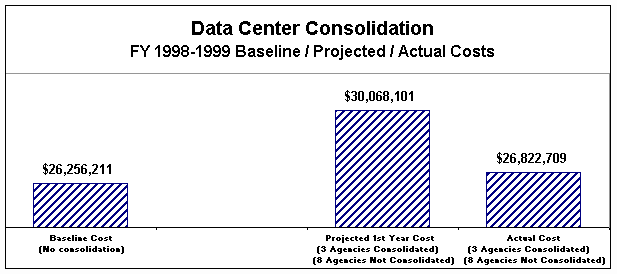
The Data Center Consolidation Study indicated that up to $30 million in savings could be achieved over a ten (10) year period if the eleven (11) targeted data centers were consolidated. The study projected that during the first year of the consolidation project the actual operating costs would be $3,811,890 higher than would have been the case in a non-consolidated environment. This anticipated one time ‘bump’ in costs resulted from the need to procure new software, hardware, facilities, and contractual assistance for the Consolidated Data Center. By minimizing contractual assistance from the systems integrator and through careful management of expenditures for personnel and software, it has been possible for the Consolidation Team to avoid the $3.8 million ‘bump’. Indeed, the actual operating cost was only $566,498 more than the baseline cost.
Pursuant to Proviso 63A.5, this report includes cost information for this fiscal year on both the actual data center environment as well as what might have been the environment if no consolidation had taken place.
Baseline Operating Environment. The non-consolidated environment is also referred to in this report as the baseline operating environment. It has been estimated for FY 1998-1999 that the cost of operating the data centers in a totally non-consolidated environment would have been $26,256,211.
Original Projected First Year Cost. The Data Center Consolidation Study projected a first year (FY 1998-1999) consolidation cost of $30,068,101.
Actual Operating Environment. For FY 1998-1999, the cost of operating the data centers in our actual partially consolidated environment (3 agencies consolidated and 8 agencies not yet consolidated) has been determined to have been $26,822,709.
Facilities
Construct a state-of-the-art Data Center Facility.
On May 13, 1997, the Joint Bond Review Committee approved a plan to construct the new Data Center at the State’s Broad River Road complex. The State Budget and Control Board on November 4, 1997 approved the design and construction of a 75,441 square-foot facility. Subsequently, on February 10, 1998, the Budget and Control Board adopted a resolution which provided for the issuance and sale of not more than $8,620,000 in State Facilities Lease Revenue Bonds, to finance the project.
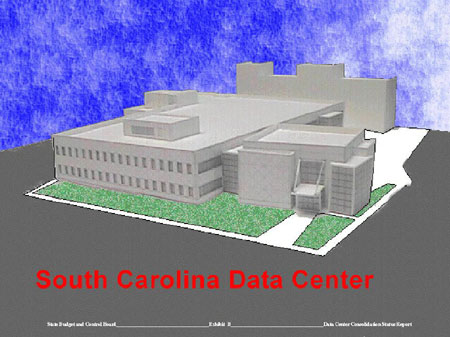
A contract for site development work was issued in April 1998 and design work was completed in June 1998. In April 1998, bids were received from five (5) contractors for construction of the building. A contract was awarded to York Construction Company for a low bid of $8,200,200. See architectural sketch – Exhibit B.
The building project has proceeded smoothly with few delays and the projected date for completion of the project is early September 1999.
Human Resources / Staffing
Establish a staffing Plan.
The Master Plan developed by IBM Global Services identified 192 staff positions devoted to data center support in the eleven (11) state agencies affected by data center consolidation. The Consolidation Team met with the agencies individually to document the specific positions involved. Assessments of the job functions of each of the positions identified were used to develop a skills profile. That skills profile is being used to staff the new consolidated data center.
Transfer of Staff Positions (FTE’s)
The Master Plan outlined a strategy to transfer key data center support staff positions (FTE’s) from their respective agencies to the Budget and Control Board as those agencies are migrated to the consolidated data center. Twenty-nine (29) staff positions have been transferred to date:
Redeployment of Staff Positions (FTE’s)
The Master Plan also outlined a strategy to reduce the 192 staff positions (FTE’s) devoted to data center support as state agencies are migrated to the consolidated data center. Reductions to date have resulted in the redeployment of sixteen (16) data center support positions (FTE’s) within the following agencies:
Network Planning
Network services at the Broad River Road Complex.
Planning for the LAN wiring infrastructure was completed and installation of both ethernet and fiber optic cabling will begin in July 1999.
A contract has been awarded for fiber optic cabling to support Asynchronous Transfer Mode (ATM) Network connectivity to the State Data Center at Broad River Road. The projected date for completion of this project is 4th quarter 1999.
Network services for consolidated agencies .
Channel extender equipment was installed and fiber optic cable was leased to provide connectivity between the Department of Social Services (DSS) and the Office of Information Resources (OIR) data center. Fiber optic cable was extended to the Department of Transportation (DOT) and channel extender connectivity established to support communications between DOT and the Office of Information Resources (OIR) Data Center.
Disaster Recovery Planning
The Data Center Consolidation Study addressed the need to improve the disaster recovery plan to ensure continuity of service to client agencies and to safeguard information technology assets against accidental or unauthorized modification, destruction, or disclosure. This evolutionary process means moving from the existing Coldsite recovery concept to the Hotsite method. To maintain up-to-date business recovery plans within this dynamic and rapidly changing environment, the Office of Information Resources (OIR) has:
Data Center Consolidation Tasks For FY 1999-2000
During the next fiscal year, particular focus will be given to standardization and automation of operations at the consolidated data center. Also, there are a number of significant tasks to be completed in implementing data center consolidation. The completion of the new State Data Center facility at the Broad River Road Complex scheduled for August 1999, and the Year 2000 Rollover are critical milestones to be accomplished before migrating additional state agency data processing operations to the consolidated data center. Data processing operations for three (3) state agencies are scheduled to be migrated to the new State Data Center in FY 1999-2000: (1) the Department of Disabilities and Special Needs (DDSN), (2) the Department of Health and Environmental Control (DHEC), and (3) the Department of Mental Health (DMH). Finally, in regards to network improvements, the Office of Information Resources (OIR) and the Department of Transportation (DOT) will embark on a joint venture to install fiber optic cable between downtown Columbia and Broad River Road. This will enable agencies to connect to the new State Data Center through high speed communications links.
Conclusion
The progress to date of the Data Center Consolidation Project is commensurate with the goals established in the Master Plan. The project is in line with both the timelines established for consolidating agency data processing operations and the cost of data center consolidation projected in the plan.
|
|
 |